Song catalogue · Lyrics available
What I Got
Scott Simpson
All songs & lyricsSong information
Release years and genres refer to the catalogued recordings. Composition credits follow Apple Music; separate writer credits follow the supplied lyric sources.
Credit sources
- Apple Music credits
- Apple Music credits
- Apple Music credits
- Apple Music credits
- Apple Music credits
- New Music Memoir (1).docx
Lyrics
Source: ScottSimpsonAllLyrics (2).pdf · pp. 72–74; ScottSimpsonAllLyrics (2).pdf · pp. 153–155; ScottSimpsonAllLyrics (2).pdf · pp. 245–247; Simpson_lyric_sheets.pdf · pp. 26; Mostly Keepers (1).doc
Other supplied versions
Scott SimpsonSpearfish Songbook Set Lyrics
Source: Scott SimpsonSpearfish Songbook Set Lyrics.pdf · pp. 2
Dancin Moon Anthology (3).docx
Source: Dancin Moon Anthology (3).docx · pp. paragraphs 1744–1797
Albums & listening
Live, remastered, and alternate arrangements may differ from the supplied lyrics.
- Nothing KnewApple Music · Find on Spotify · Find on Amazon Music
- Live in the Black HillsApple Music · Find on Spotify · Find on Amazon Music
- Circuitous & Before the Great Divide (Remasters)Apple Music · Find on Spotify · Find on Amazon Music
- Being Human (The Songs)Apple Music · Find on Spotify · Find on Amazon Music
- Four RestoredApple Music · Find on Spotify · Find on Amazon Music
Recording details (5)
Circuitous & Before the Great Divide (Remasters) · What I Got (Remastered)
Listen on Apple MusicBeing Human (The Songs) · What I Got
Listen on Apple MusicFour Restored · What I've Got (Restored)
Listen on Apple MusicNothing Knew · What I Got
Listen on Apple MusicLive in the Black Hills · What I Got (Live)
Listen on Apple MusicSong story & origins
Introduction
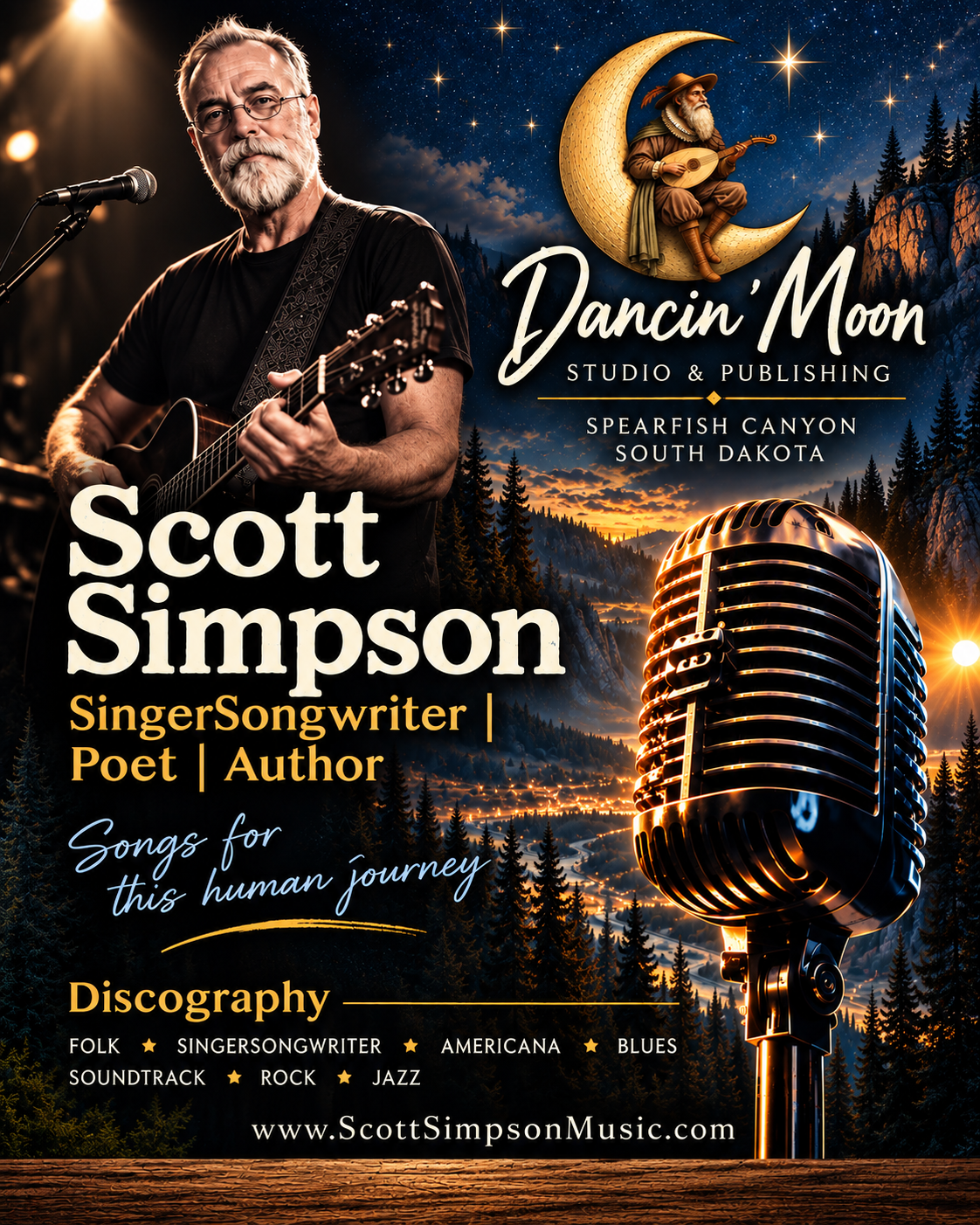
What I Got gave my studio its name: Dancin’ Moon. I wrote it around 2003, in a season when I was licking my wounds and trying to figure out how to keep making art. It first appeared on Circuitous (2004), recorded while we were living in Texas and spending summers working at a camp in New Mexico. I came back to it—very differently—on Nothing New (2007), and again on Live in the Black Hills, Vol. 1 (2014). The three versions trace a real arc: early fast and witty, then slow and mournful, then steadied and balanced.
Where the song came from
The piece grew out of a pivotal professional loss. I was on the tenure track, publishing poems and teaching both creative writing and teacher education. The person over my tenure case—an entomologist and fine scientist, but no champion of poetry—made it clear that my publications “didn’t count” the way lab research did; the bar was framed as “a pile of poetry equals one research article.” I didn’t get tenure. We moved south. I taught a year at another university I loved, then felt the need to step completely out of academia and direct a camp I cared about.
That’s the wound-licking context. I still believed I was a poet, but the external message said otherwise. So I turned toward songwriting and recording, where I didn’t need anyone’s gatekeeping to make work and share it. The first section of the lyric is a deliberate stack of impossibilities—poet with no pen, priest who can’t hear God, dancer with club feet, farmer who can’t break the sod—images of identity blocked by circumstance. They’re funny-sad on purpose; that humor let me keep moving.
The turn: moon across the water
Midway through, the song turns. After “some folks get the short end,” I reach for grace: I set out to touch the moon… couldn’t get past the sea… then the moon… danced across the waves… she came to me. Anyone who’s watched moonlight walk a path over the ocean knows the picture. For me that’s art—the way a song, made with “an empty hand and an open heart,” can close the distance you can’t cross by force. That image is why my studio eventually took the name Dancin’ Moon—a reminder that, even against a wall, light can move toward you.
Versions and evolution
Circuitous (2004) — fast, witty, defiant. I wrote and cut the original while we were in Texas (summers in New Mexico). It darts from image to image like I was racing the feelings—refusing to be flattened by the setback.
Nothing New (2007) — slow, mournful, bare. By then we’d had what I call three strikes: the tenure loss; a painful, ugly parting with the camp; and a church job that pushed me out for being too progressive (some would say heretical). In Colorado I set up a tiny closet studio and sang these songs almost at a whisper. I added wooden flute here—the instrument’s ache fit the year.
Live in the Black Hills, Vol. 1 (2014) — steady and matured. No longer brash, no longer crushed—just honest about the losses and the gifts folded together. The performance sits between the first two: not fast, not dirge, but resolved.
In 2008—when we moved back to Spearfish—I rebuilt my studio. It first wore the name Ironwood, then I renamed it Dancin’ Moon, because this song’s central mercy had become a daily practice.
What the song is saying
It isn’t about bargaining with the universe (“If I do X, I’ll earn Y”). It’s about what you give “when the rest will not”—about bringing the gift you still have even when other tools have been taken away. The tag lines put a frame on that:
“The poem don’t need the pen”—the essence can exist before it’s formalized.
“The priest… can’t speak for God”—beware anyone who claims authority over mystery.
“Dance as graceful as you can / till they lay you down in the sod”—do your best work, however imperfect your feet; and don’t be afraid of the rest to come.
Even that burial image carries peace when it circles back to the farmer and sod—earth and rest folded into the same story.
Why it stays with me
Because it has carried me through failure and recovery more than once, and it keeps me focused on the part I can do: make something true, something people can connect to—connection that runs both ways. If the sea is between me and the moon, I can still sing. And sometimes, when I do, the moon crosses the water.
Source: New Music Memoir (1).docx
From the Being Human journal
I wrote What I Got at a time when a series of failures had left me licking my wounds. What happens when you work and work for a big dream… only to come up against an impassible barrier? Sometimes, grace happens. Sometimes, when you set out to touch the moon and can’t realistically make it… then moon closes the gap… she treads across the water to dance with you.
Source: Being Human: The Songs — Album & Journal (2020) · p. 13
Being Human · The Songs
Reflection & journaling
Theme: Grace
Choose a question or word or line(s) from the lyrics to guide your meditation or journaling as you listen.
- Do I attribute my successes to my own hard work?
- Do I attribute my failures to my own mistakes or weaknesses?
- Is there room for something beyond me to intervene, to close the gap?
- Is there anything “beyond me” benevolent enough to do that?
- How expectant am I of the impossible somehow becoming possible?
Source: Being Human: The Songs — Album & Journal (2020) · p. 13
Open the complete journal